Built around your child, not around a curriculum.
Most tutoring starts with a syllabus and tries to fit your child to it. Maker Math starts with your child, then figures out what they need. Here is how that actually works.
From first conversation to first session.
The first conversation
You reach out. We talk through what is going on. What is your child struggling with, what has been tried, what does school look like, what do you hope changes. This call is free and there is no commitment.
The assessment
Before the first real session, your child meets with a Maker Math tutor for a working assessment. We are not testing them. We are figuring out where their understanding is solid, where the gaps are, and how they think when they hit something hard. The assessment usually takes about an hour.
The plan
Based on the assessment, we put together a plan. Which concepts to start with, which tools to use, what pace makes sense. The plan is not a contract. It changes as your child does.
Twice a week, every week
Real sessions begin. One hour each, two times a week, year round. The work is steady, hands on, and built around what your child actually needs. You will be updated on progress after every session.
One hour,
one student,
one tutor
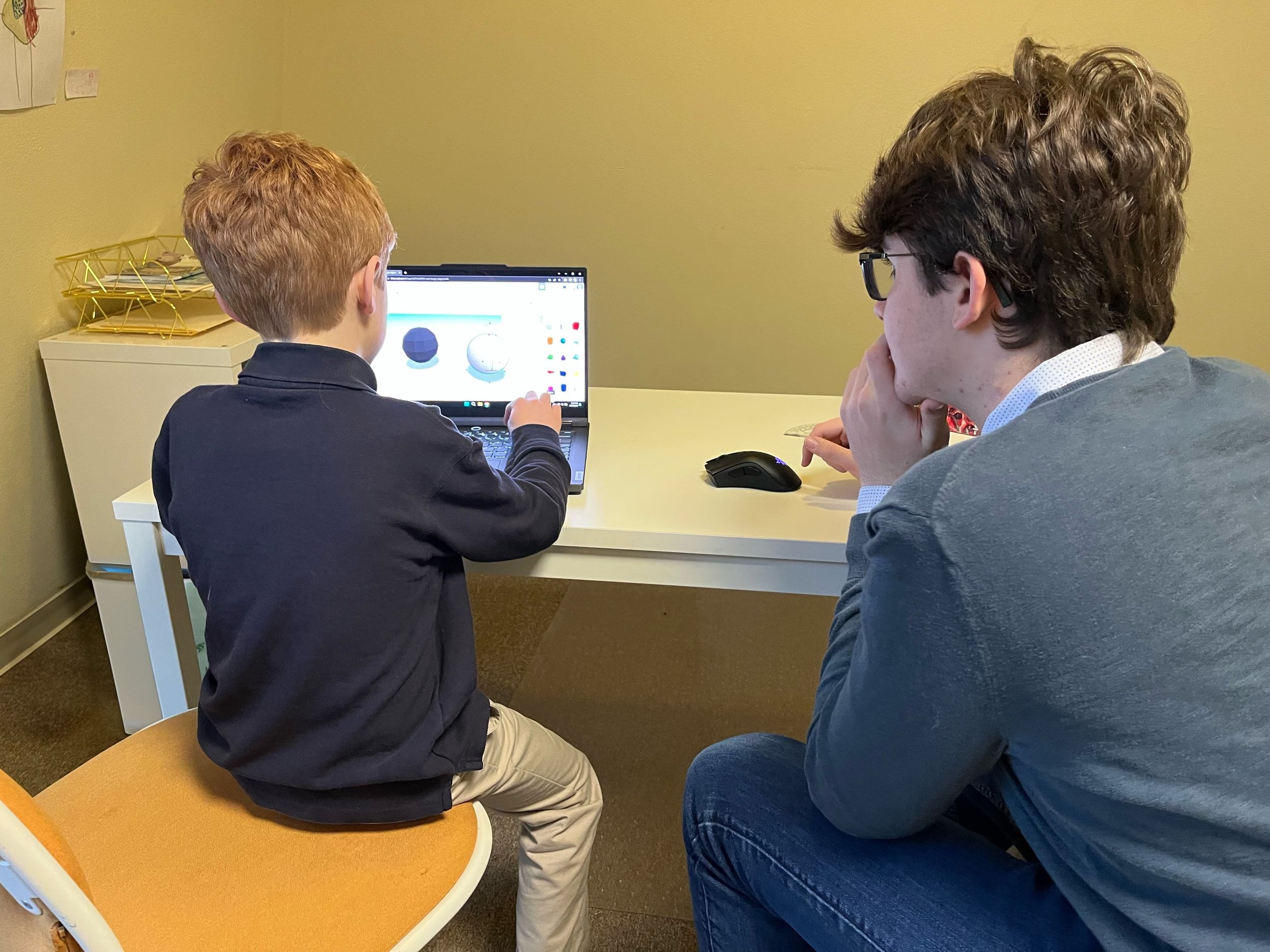
Sessions run for an hour. Just the student and their tutor, working at a table with whatever tools the lesson needs. No group instruction, no rotating tutors, no waiting your turn.
A typical session might start with a quick check-in on what the student remembers from last time, move into the new concept with a hands on tool to anchor it, then close with a few problems that put the new idea to work. Some sessions are mostly conversation. Some are mostly building. The shape of the hour follows what the student needs that day.
Math you can hold, see, and reason through.
Different students need different ways in. Maker Math tutors use whatever tool fits the moment. Sometimes that is a worksheet. Sometimes it is a custom 3D printed manipulative. Sometimes it is a conversation about what the symbols actually mean.
Multisensory by design.
Students see the math, hold the math, and explain the math out loud. Concepts get stored across multiple kinds of memory, not just on a flat page.
Custom tools when they help.
Maker Math has a 3D printer in house. When a student is stuck on a concept and the right manipulative does not exist yet, a tutor designs and prints one, often within a day or two.
Programs that actually work.
Maker Math draws on proven approaches like Math U See and the work of dyscalculia researcher Ronit Bird. We are not making this up as we go.
What committing to Maker Math looks like.
Maker Math runs year round. Students attend two one-hour sessions per week, on a consistent schedule with the same tutor. Sessions can be in person at our centers in Camp Hill PA or Avon NC, or online from anywhere in the country.
The twice-a-week rhythm matters. Math is built up, not crammed. Students who come once a week tend to forget half of what they learned by the time they come back. Students who come twice a week build real foundations.
Sessions are held year round, including through summer. Math is a use it or lose it skill, and the summer break is where most of the regression happens. Maker Math families avoid that.
If a session needs to be rescheduled, just tell us. The cancellation policy is clear and reasonable.
Want to see if Maker Math fits your child?
Reach out and tell us about your child. We will get back to you within two business days to set up a free first conversation.
Get in touch