The problem with how math is usually taught.
American math education has a few features that make it harder than it needs to be:
It moves too fast. State standards and standardized tests push teachers through a long list of topics every year. There is rarely time to slow down and make sure students actually understand a concept before the next one builds on top of it.
It teaches procedures, not reasoning. "Here is the formula, here is how to apply it, do twenty practice problems." A child can learn the procedure for long division without ever understanding what division actually means. That works fine until the procedures get complicated, and then the missing foundation collapses.
It is mostly flat. Math lives on paper, in symbols. A circle is a circle drawn on a worksheet. A fraction is a number written above another number. The actual quantities, the actual relationships between numbers, never quite become real for the student.
It is verbal-heavy. Teachers explain math out loud, students listen, then try to do problems. For students who learn well by listening, this works. For students who do not, it is a daily fight.
The result is a generation of children who can sometimes do math but rarely understand it, and a smaller group of children who cannot even do it because the procedures never stuck. The first group is fragile. The second group looks like it is failing math when really, math is failing them.
What happens when math becomes dimensional.
A triangle drawn on a worksheet is just three lines. The student is told that the angles add up to 180 degrees. They write it down. Maybe they memorize it for the test.
A 3D printed triangle that the student can hold, with three sides that snap apart, is a different experience entirely. The student takes the triangle apart. They put the three sides together end-to-end and discover they form a straight line. A straight line is 180 degrees. They have just proven the theorem with their own hands.
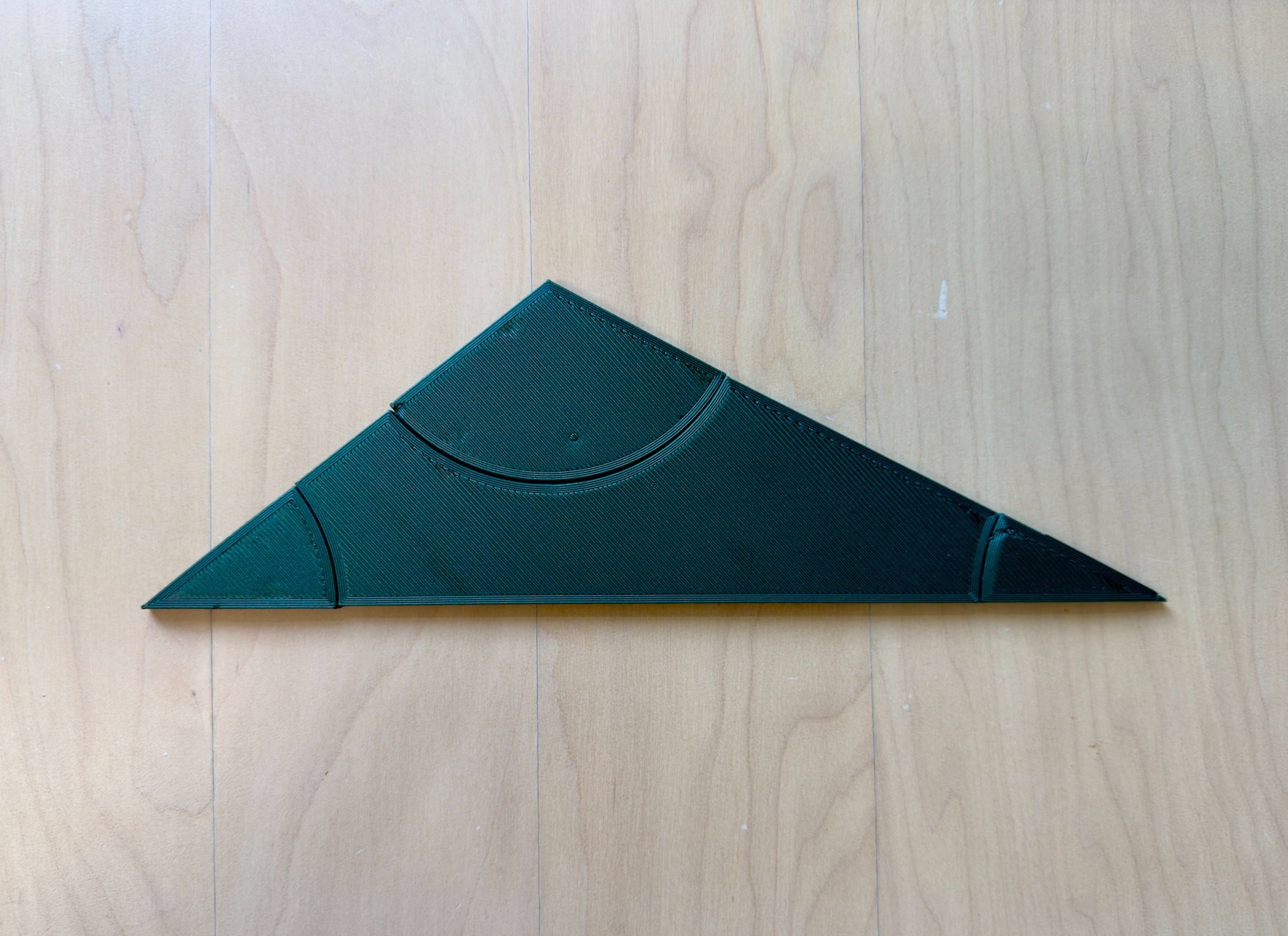
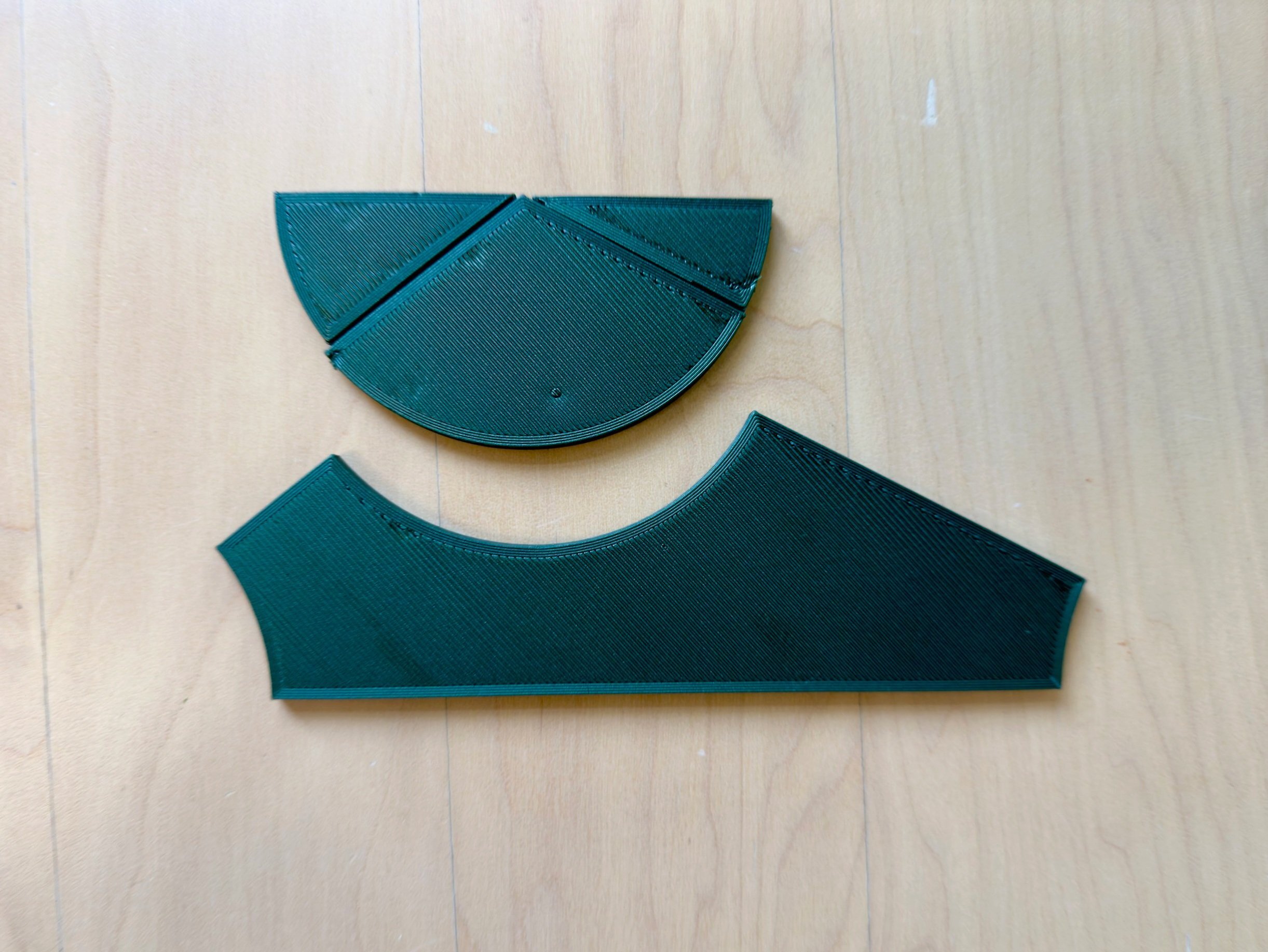
They do not just know that the angles of a triangle sum to 180 degrees. They have built the proof. They could not unknow it if they tried.
This is the difference between flat math and dimensional math. The information is the same. The understanding is on a completely different level.
Now apply that to fractions. A worksheet shows that 1/2 equals 2/4. A set of 3D printed fraction wedges that physically combine, where two quarter-pieces visibly fill the same space as one half-piece, makes the equivalence obvious. The student does not need to memorize the fact. They have seen it.
Apply it to negative numbers, geometry, ratios, algebraic manipulation, calculus concepts. Every level of math has concepts that become dramatically easier when they become physical. The student stops fighting the symbols and starts working with the actual relationships.
What the research actually says.
Multisensory math instruction has been studied for decades. The findings are consistent: students learn better when they engage multiple senses simultaneously, especially for foundational concepts.
A few of the patterns that show up in the research:
Concrete-Representational-Abstract (CRA) is well-validated. Students who first encounter a math concept with concrete materials, then with visual representations, then with abstract symbols, build deeper understanding than students who skip straight to abstraction. This sequence has been used effectively for decades, especially with students who have learning differences.
Multisensory engagement aids retention. Information encoded through multiple senses is stored across multiple memory systems. A student who saw a concept, touched it, talked about it, and worked with it physically has more anchors for retrieval than a student who only saw it on paper.
Hands-on learning helps non-verbal reasoners. A significant portion of students do not learn well through purely verbal explanation. For these students, hands-on instruction is not just helpful. It is the only thing that consistently works.
Manipulatives reduce cognitive load. Working memory is finite. Holding a problem in physical form, where the student can see and touch the parts, frees up working memory for the actual reasoning. This is especially helpful for students with ADHD or working memory weaknesses.
The published research on 3D printing in math education is newer and smaller, but early findings are encouraging. Students who use 3D printed manipulatives report higher engagement and demonstrate better conceptual understanding than students using only flat representations.
Concrete versus abstract, and why the order matters.
One of the most important ideas in math education is also one of the simplest: students need to encounter mathematical concepts concretely before they encounter them abstractly. Skipping this step is the source of an enormous amount of math struggle.
A child who has played with sets of 3 blocks, 5 blocks, and 8 blocks knows in their bones that 3 + 5 = 8. The symbol "8" is not an arbitrary mark. It represents a specific quantity they have seen, held, and counted. When that child later sees "3 + 5 = ?" on a worksheet, they have something to reach for. The symbols connect to real meaning.
A child who skipped the concrete stage and started with the symbols sees "3 + 5 = ?" as a puzzle to solve through procedures. They might learn to write "8" in the blank, but the answer is meaningless to them. It is just the right shape to put there.
This sounds like a small distinction. It is not. By the time math gets complex, the children who built understanding from the ground up are dramatically further along than the children who only learned procedures. The procedural children hit a wall. The conceptual children keep going.
Hands-on, multisensory math instruction is essentially a way of restoring the concrete stage that traditional math instruction skips. It is not a remedial technique. It is the foundation that should have been there the whole time.
Why 3D printing changes things.
Physical manipulatives are not new. Counting blocks, fraction circles, base-ten rods, and pattern blocks have existed for decades. Schools have them. Teachers know about them. So why are children still struggling?
A few real reasons:
The off-the-shelf manipulatives are limited. Standard sets cover the most common concepts, but they leave huge gaps. There is no commercial manipulative for "the relationship between sine and cosine" or "the way a quadratic graph shifts when you add a constant." Teachers either skip the hands-on approach for those topics or improvise with whatever is on the shelf.
Custom manipulatives have always been expensive. Designing and producing a single specialized teaching tool used to require a manufacturer, lead time, and significant cost. For a one-off classroom need, this was not realistic.
3D printing collapses the cost and time. A tutor who notices a student struggling with a specific concept can now design a custom manipulative for that concept and have it printed within hours. The barrier between "I see what this child needs" and "I have the tool to teach it" has gone from weeks and hundreds of dollars to one afternoon.
This changes what is possible. Maker Math has a growing library of 3D printed manipulatives covering topics from basic counting to calculus, with new tools designed regularly based on what specific students need. Some are obvious extensions of classic manipulatives. Others are concepts that have never had a physical form before.
When a tool is shaped exactly to the concept the student is stuck on, the learning becomes much more efficient. The student is not adapting their thinking to whatever generic manipulative is available. The manipulative is adapted to them.
What this looks like in a Maker Math session.
In a typical Maker Math session, a tutor and student sit at a table with whatever tools the lesson needs. The math is the goal, but the path looks different from a typical math class.
A few things that might happen:
- The student handles a tool first, then talks about what they notice. Discovery before explanation.
- The tutor introduces a concept by building it together with the student, not by explaining it on a whiteboard.
- The student does some problems on paper after they have understood the concept physically, not before.
- When the student gets stuck, the tutor reaches for a tool, not for a louder explanation.
- If the right tool does not exist yet, the tutor might print one for the next session.
The student is not memorizing procedures and reproducing them. They are building understanding from the ground up, with their hands and their reasoning. The math is something they have made, not something they have been given.
This is how math used to be done, before classrooms got crowded and curricula got compressed. Hands-on, one-on-one, with real tools and real time. Maker Math is not inventing a new way of teaching math. It is bringing back a way of teaching that has always worked, made better by tools that did not exist a generation ago.
About Maker Math
Maker Math is the practical version of everything described on this page. One-on-one, hands-on, with custom 3D printed tools made for your child's specific learning needs. If you want to see how this works for your family, talking to us is the first step.
Get in touch